
Baby Milestones From 0 to 24 Months: What to Notice
Milestones are useful signposts, not a competition. Here is what to notice across the first two years and how to turn observations into better conversations with your child's clinician.
Published July 29, 2026 · By Egspect Editorial
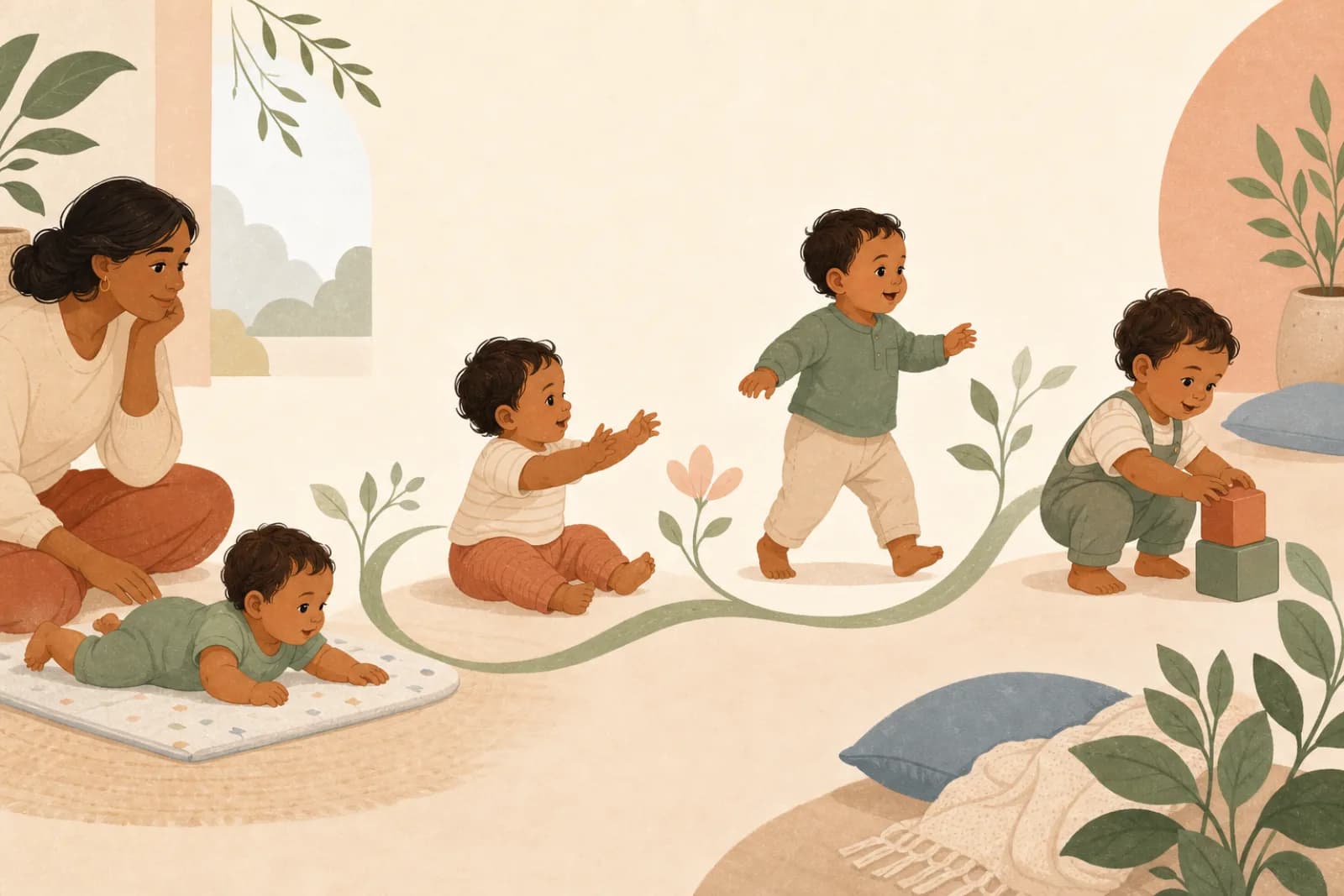
Baby milestones are skills most children can do by a particular age across four connected areas: social and emotional development, language and communication, thinking and learning, and movement and physical development. They are observation prompts—not deadlines and not a diagnosis.
The most helpful habit is simple: notice what your child does in everyday life, celebrate new skills, and share an age-based checklist plus any concerns at health visits. If something worries you, act early rather than waiting for an app to turn red.
Browse the free Egspect pregnancy and baby tools, or start a shared family timeline to keep everyday notes and milestones where both parents can see them.
Medical note: This guide is general information, not medical advice, and cannot assess a child's development. Milestone expectations, screening schedules and referral pathways vary by country. Your child's qualified clinician should interpret development in context, including prematurity, hearing, vision, health and family observations.
TL;DR: what changes from birth to age two?
| Age range | What you may begin to notice | What helps most |
|---|---|---|
| Birth to 3 months | Faces, voices, head control and early social smiles | Face-to-face talk, responsive comfort and supervised floor time |
| 4 to 6 months | Laughter, reaching, rolling and back-and-forth sounds | Safe reaching, songs, books and imitation |
| 7 to 9 months | Sitting, transferring objects, babbling and name response | Peekaboo, containers and safe movement space |
| 10 to 12 months | Gestures, simple games, pulling to stand and early words | Name objects, respond to gestures and let the child explore safely |
| 13 to 18 months | Independent steps, pointing to share interest and more purposeful words | Narrate routines, offer simple choices and practice daily tasks |
| 19 to 24 months | Two-word combinations, running, pretend play and problem-solving | Conversation, pretend play, movement and simple puzzles |
These are broad themes, not a substitute for the age-specific CDC developmental milestone checklists. The CDC checklists cover ages from two months through five years and are designed around skills most children—at least 75 percent—would be expected to achieve by each listed age.
What do milestones measure?
Development does not happen in isolated boxes. Reaching for a toy involves vision, attention and motor planning. Pointing at an airplane involves movement, shared attention and communication. That is why milestone monitoring looks across several domains:
- Social and emotional: connection, expressions, play and responses to other people.
- Language and communication: sounds, gestures, understanding and spoken language.
- Cognitive: attention, exploration, imitation, memory and problem-solving.
- Movement and physical: head and trunk control, hand use, sitting, standing and walking.
Growth measurements such as weight or length are different from developmental milestones. Both matter, but a growth chart cannot show language development, and a milestone checklist cannot assess nutrition or physical growth.
What might you notice from birth to 3 months?
Early development is built around regulation and connection. Newborn movement can look jerky, sleep is distributed across day and night, and communication is mostly crying, facial expression and body movement.
By around two months, CDC examples include calming when spoken to or picked up, looking at a face, smiling in response, making sounds other than crying, watching a person move and holding the head up during tummy time.
Support development by:
- responding to cries and cues;
- talking during feeding, dressing and diaper changes;
- giving supervised, awake tummy time in short sessions;
- placing faces and safe high-contrast objects within view; and
- reducing stimulation when the baby looks away, stiffens or becomes unsettled.
Safe sleep and supervised play are different contexts. Follow local safe-sleep guidance whenever the baby is sleeping; tummy time is for an awake baby with an attentive adult.
What might change from 4 to 6 months?
The baby becomes more active in conversations. You may hear chuckles, squeals and strings of sounds, see deliberate reaching, and notice stronger head and trunk control.
CDC's six-month checklist includes recognizing familiar people, laughing, taking turns making sounds, reaching for a wanted toy, exploring objects with the mouth, rolling from tummy to back and leaning on hands while sitting. Individual children may show skills in a different order.
Useful play does not need specialist equipment:
- Put a safe object just within reaching distance.
- Copy the baby's sound, then pause for a response.
- Read a sturdy book and name one picture at a time.
- Offer safe objects with different textures and shapes.
- Let the baby move freely on a safe floor rather than spending long periods in positioning devices.
What might change from 7 to 9 months?
Mobility and object exploration expand. The baby may sit with less support, move objects between hands, rake food or objects with fingers, and look for something that drops out of view.
At nine months, CDC examples include showing several facial expressions, looking when their name is called, reacting when a caregiver leaves, making repeated sounds such as “mamamama,” banging objects together and getting into a sitting position.
Separation reactions often become stronger because the child now recognizes familiar people and notices their departure. Calm, predictable goodbyes are more helpful than disappearing secretly.
This is also the point to review the home from floor level. As movement changes, hazards change. Secure medicines, button batteries, cords, hot liquids, stairs and furniture according to local child-safety recommendations.
What might change from 10 to 12 months?
Communication becomes increasingly intentional. A child may wave, play a simple game, understand familiar words, use a name for a parent, put an object into a container, pull to stand or walk while holding furniture.
The CDC one-year checklist includes playing games such as pat-a-cake, waving goodbye, understanding “no,” looking for hidden objects and picking up small items between thumb and finger.
Walking independently is not a requirement for a first birthday. Avoid comparing one highlight from another child with the full pattern of your own child's development.
Help by naming what the child is looking at, answering gestures with words, offering containers to fill and empty, and giving safe opportunities to pull up and cruise.
What might change from 13 to 18 months?
Toddler development combines growing independence with a continuing need for closeness. Words, gestures and movement may advance quickly, but frustration also rises when ideas exceed communication skills.
By 18 months, CDC examples include moving away while checking that a caregiver is nearby, pointing to show something interesting, trying to say three or more words besides parent names, following a one-step direction without a gesture, walking independently, scribbling and trying to use a spoon.
The 18-month period is an important moment for developmental screening in some health systems. Screening is a standardized assessment; milestone monitoring is the observation families and professionals do over time. Ask what screening schedule applies where you live.
Create language opportunities by pausing, following the child's focus and adding one simple word. If the child points to a dog, “dog—big dog” is more connected than testing them with repeated questions.
What might change from 19 to 24 months?
Around age two, many children combine words, run, kick a ball, eat with a spoon and use one object to represent another in pretend play. The CDC two-year checklist includes noticing when others are upset, looking at a caregiver's face in a new situation, pointing to pictures in a book, saying at least two words together, using switches or knobs on toys, running and walking up a few stairs with help.
Language exposure varies across families. Learning more than one language does not cause a language disorder. Share words and examples from every language the child uses when discussing communication with a professional.
Toddlers learn through repetition. Reading the same book, pouring the same cups and repeating the same pretend meal are productive practice, even when adults find them monotonous.
How should prematurity affect milestone tracking?
For a child born early, clinicians may use corrected age: chronological age minus the number of weeks born before 40 weeks. A six-month-old born eight weeks early may be assessed closer to a corrected age of about four months. American Academy of Pediatrics guidance explains that corrected age can give a more useful developmental comparison during the first two years.
How long corrected age is used depends on the child's history and the care system. Do not calculate alone and assume a concern can wait; ask the neonatal or child-health team which age to use and when.
When should you act early?
You do not need to diagnose the reason before asking for help. CDC guidance for concerned families recommends completing the child's milestone checklist and sharing concerns with the doctor. Acting early can improve access to assessment and support.
Contact a qualified professional when:
- a child loses a skill they previously used;
- one or more age-based milestones are missing;
- you are concerned about hearing, vision, movement, communication or connection;
- feeding or swallowing seems unsafe;
- one side of the body is used very differently; or
- your intuition says the pattern needs attention.
A reassuring comment from a friend is not developmental screening. Ask for your concern and the next step to be documented.
What should parents track?
- Use the child's age-specific checklist, adjusted for prematurity if the care team advises it.
- Record concrete examples: “does not turn when name is called” is more useful than “communication seems off.”
- Add context: note whether the skill appears at home, childcare or with familiar people.
- Bring short videos when safe and appropriate; a clinician may find them helpful.
- Share strengths too. A complete picture is more useful than a list of worries.
- Ask for the next decision: monitor, screen, assess hearing or vision, or refer for evaluation.
Milestones belong in a family record, not a family competition. Use Egspect to save moments and make observations visible to both parents without turning childhood into a score.
Related reading and tools
- Free pregnancy and baby tools
- Complete newborn care guide
- Feeding schedule calculator
- Baby sleep schedule calculator
- Baby name generator
- Start a shared family timeline
- Pregnancy week by week: trimester guide
- A pregnancy guide for fathers and partners
- Hospital bag checklist: what you actually need
- CDC developmental milestones
- WHO nurturing care for early childhood development
Milestone guidance was reviewed and accurate as of July 29, 2026. Checklists and local referral pathways can change.
Frequently asked questions
What are developmental milestones?
Developmental milestones are skills most children can do by a certain age in how they play, learn, speak, act and move. They help families and clinicians monitor development but do not diagnose a condition.
Do all babies reach milestones at the same age?
No. Development varies, and a single skill may appear earlier or later. Age-based checklists help identify patterns and concerns that deserve discussion rather than grade a child.
What should I do if my baby misses a milestone?
Write down what you observe, complete an age-appropriate checklist and share it promptly with your child's doctor or qualified health professional. CDC guidance emphasizes acting early rather than waiting when a caregiver is concerned.
Is losing a skill a reason to seek help?
Yes. Tell a qualified health professional promptly if a child loses a skill they previously had or if you have concerns about the way they play, learn, speak, act or move.
Should age be adjusted for a baby born prematurely?
Clinicians may use corrected age when assessing development in children born preterm, especially during the first two years. Ask your child's care team which age they want you to use.
Egspect keeps pregnancy weeks, baby milestones and shared family logs ready without making the day feel like a medical dashboard.
Create my family space